Technique and Intention
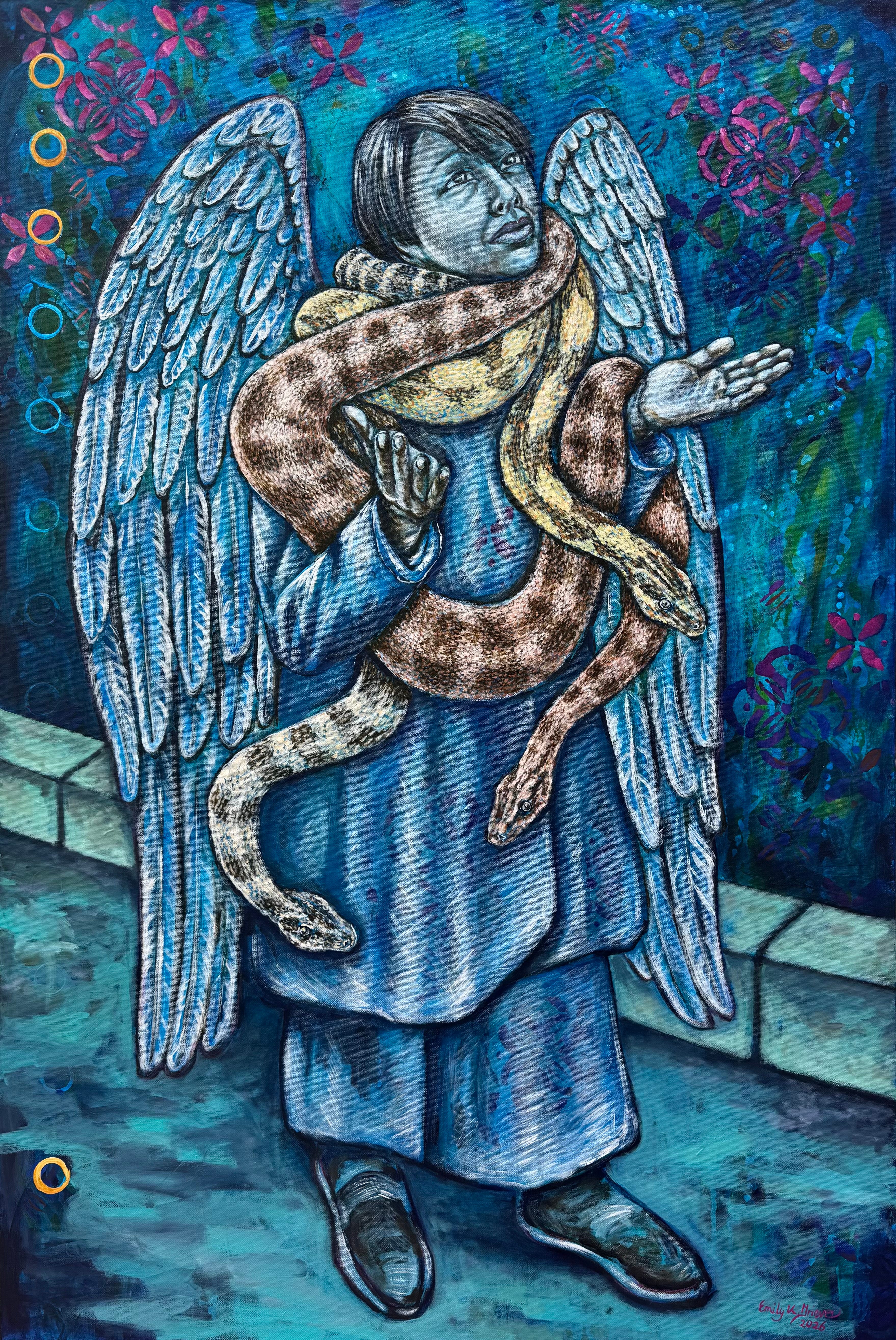
On the Border Between Energy and Matter

Dear Creative Beings,
What I am sharing with you today is really kind of a work in progress… It’s difficult for me sometimes to write about myself and my artwork, especially in more traditional ways. But someone asked me to “describe my technique” to them… the question, or request rather, startled me in a deer-in-the-headlights kind of way. My technique?
Technique as a word or concept evokes something academic to me, something upon which I will be critiqued or graded or judged. Perhaps it refers to the materials I use, i.e. acrylic paint versus oil paint or watercolor, or perhaps it refers to “painting” in general versus, say, printmaking or drawing or sculpture. Maybe the word “technique” refers to technical skill, which is always a morphing growing sometimes looming requirement to feel even remotely good about our work sometimes.. and it’s the most vulnerable aspect, the part that takes me back to a certain nasty college professor or two. Maybe it refers to technical methods, how one applies the paint to achieve certain effects… or maybe it refers to styles like figurative, representational, abstract, photo-realism, impressionist, expressionist… I truly do not know.
But here is where I talk about my art, some of the technical things and some of my inspirations. I think that technique and intention must both be considered, as intention seems to be what breathes life into the visions that make art work meaningful, while technique is how you achieve bringing the visions into form!
My art work straddles parallel paths that can be described as Visionary Art and Intentional Creativity. These two “schools” share many similarities in that both involve some sort of visioning/visualization processes and both acknowledge some sort of “non-ordinary” reality operating beyond what we normally perceive as our ordinary reality. Both recognize the power of our imagination to create positive change in our lives, in our common experience as a part of humanity, and in humanity as an integral part of all of creation. Both recognize that creativity is both a birth right and a responsibility, and that we can use our creativity to create the best possible reality for a higher good.
One of the visionary art techniques I use in my paintings is called the Mischtechnik, which was developed by a group of painters in Vienna, Austria, in the 1950’s an 60’s when they started experimenting with psychedelics and then wanted to better portray the visions they had. They retrieved old Northern Renaissance techniques in order to portray greater luminosity from the inside out. One of these painters was Ernst Fuchs, and I studied with one of his principal former students, master teacher Amanda Sage, who was co-founder of the (now-defunct) Vienna Academy of Visionary Art and is the founder of the Vision Train, an enormous online visionary art community and school. She now lives in Colorado, USA.
The Mischtechnik is traditionally done in egg tempera (or casein, made from milk emulsion) and oil paint, but Amanda taught us how to do the technique in acrylic paint, which is what I work in. It involves making a drawing in dark paint and covering it with a (traditionally) red imprimatura (a transparent first layer). Then one proceeds with painting “in reverse,” i.e., painting only highlights with white paint and what are called optical grays (white applied transparently in such a way that the color beneath still shows through). The dimensionality of the piece comes through defining lights rather than defining shadows. The process moves through 2 more layers of transparent colored glazes (traditionally a yellow/raw sienna as the second glaze, and a cobalt, ultramarine or manganese blue as the third glaze) and repainting of the whites and optical grays. After the third and final painting of the whites, then the final colors are introduced to complete it. This technique is similar in some ways to grisaille (gray scale) painting, but the effect of the colored glazes in this technique is to provide a richly colored depth and an effect of light emanating from deep within the painting.
I often adapt the technique to other methods I’ve worked with for many years, mainly Intentional Creativity. Intentional Creativity (or IC for short) is less about technical skill or working with certain techniques and more about a school of thought – it is more about approaching art making as a tool for healing, spiritual growth, self-discovery, intuitive development, and exploration of the nature of Creation and our place within it. I studied IC for many years with my dear friend and master teacher Shiloh Sophia McCloud, from Sonoma, California, who in turn studied with her mothers/mentors Caron McCloud and Sue Hoya Sellars, who in turn studied with Lenore Thomas Strauss, who worked for Eleanor Roosevelt using Intentional Creativity to create large scale public art work during the Great Depression. I consider Visionary Art (including the Mischtechnik) and Intentional Creativity to be parallel tracks on the same railroad, each complimenting the other and moving us forward to a brighter vision for the future.
Intentional Creativity is just that – creating with intention. It means to be aware, to be mindful, to be prayerful in every mark we make on the canvas. It means creating an intention when beginning a painting, so as to direct the energy of our creative act toward something larger than ourselves, to connect with the source of inspiration and allow ourselves to enter into that flow of energy. It means acknowledging our connection to all of creation, taking responsibility for our place in it, and knowing that the prayers we make through the paintbrush do have a real effect in that web of creation.
One of the most important parts of the painting for me is, in fact, the setting of intentions and prayers at the very beginning of approaching the new canvas. A canvas is a portal, and the painting process is the work of opening the portal, not only for oneself but for all who will eventually come into contact with the painting. I fill that portal with prayers that all who come upon it may receive what they need. I often bless my canvases with holy water from the Basilica of the Virgin of Guadalupe. I rub flower petals from my garden over the canvas or sprinkle it with flower essences or even soil from holy sites. Then I begin to paint with very loose watery strokes, allowing my hand to move as it wishes, completely freely, making shapes or symbols that arise on their own. I also often channel and paint “light codes,” symbols that come through in an automatic-writing sort of way, anchoring highly refined energies into the colorful surface of the portal emerging on the canvas.
Once I’ve completed the underpainting phase of the process, then I do a visualization to receive the actual image itself that wants to emerge. Sometimes I do this in a simple silent meditation and sometimes I do a shamanic journey, entering into an altered state of awareness to the rhythm of a drum, asking for information and imagery to come forth related to my initial intention and then documenting and recording it through writing and drawing when I complete the inquiry. Through this process, it is as if I am beginning a conversation with the painting itself (and any figure who shows up there), with my own inner muse, and this dialogue lasts throughout the painting process. It requires softening my awareness and listening deeply from my heart rather than my mind.
When I complete a painting, I usually imagine that I am handing my pen to the painting and asking it to write me a message to help me understand the energies of the new portal that has been created. These “channeled” messages have proven to be very helpful in integrating the process and also for future viewers of the painting to understand their resonance with the images.
The process of art making for me is a merging of my studies of “Visionary Art” and “Intentional Creativity” as modern movements, but both of these movements are founded on and acknowledge deeper ancestral roots, the artistic heritage of humanity, creative traditions and millennia-old methods for understanding the nature of reality and our place in the world. For me, this comes into sharper focus based on where I live, in Teotihuacan, Mexico, near 2000-year-old pyramids built by a culture that specifically studied and honored the relationship between Creator and Creation. The Teotihuacanos adorned every surface of their vast city, from murals on grand temples to ceramic bowls for daily use, with symbols and images that reminded them of the dual nature of life on Earth and the divine energy of duality merging into one whole, One Consciousness. They understood the creative act as an emulation of the Great Creator, connecting them to the inherent whole of Creation.
My artwork has been profoundly inspired by living next to the pyramids of Teotihuacan, studying the imagery left behind and still visible today, and integrating it with the teachings of Intentional Creativity and Visionary Art by which I’ve been blessed in this modern day. If I use any technique at all when I paint, may it be the technique of listening and seeing from the heart, yearning for union and connection with the Divine, with Creator, with Creation.
I’m also preparing for my solo show coming up soon, opening on June 26, at the Centro Regional de Cultura de Texcoco. It’s a great practice for me to contemplate these questions about my work as part of the prepartion. Any opportunity to attempt to explain what I do is an opportunity to integrate the dreams in my paintings in a deeper way. Thank you so much to the person who asked “What is your technique?” and to anyone else with inspiring thoughtful questions.
Love, Emily xoxo
Image: “On the Border Between Energy and Matter,” Acrylic on canvas, 80x120 cm, Copyright 2026 Emily K. Grieves www.EmilyKGrievesArt.com